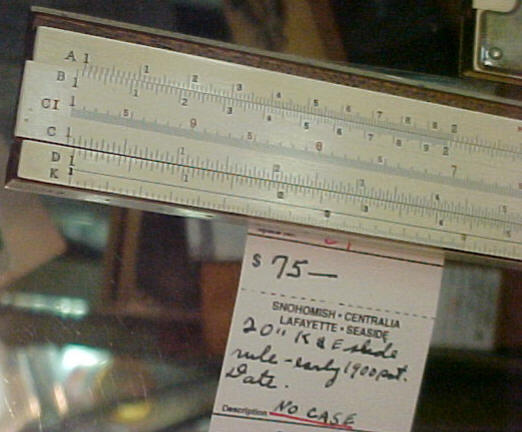
K&E (Keuffel + Esser Co) slide rule
$75.00 K+E
Slide rule SOLD
|
|
|
K&E (Keuffel + Esser Co) slide rule
$75.00 K+E
Slide rule SOLD
|
This was a great time saver but there was still quite a lot of work
required. The mathematician had to look up two logs, add them together
and then look for the number whose log was the sum. Edmund Gunter soon
reduced the effort by drawing a number line in which the positions of
numbers were proportional to their logs.
The scale started at one because the log of one is zero. Two numbers
could be multiplied by measuring the distance from the beginning of the
scale to one factor with a pair of dividers, then moving them to start
at the other factor and reading the number at the combined distance.
Picture of a 2 foot Gunter scale (~110K) The
yellow spots are brass inserts to provide wear resistance at commonly
used points.
Closeup on the Gunter scale (~72K)
Soon afterwards, William Oughtred simplified things further by
taking two Gunter's lines and sliding them relative to each other thus
eliminating the dividers.
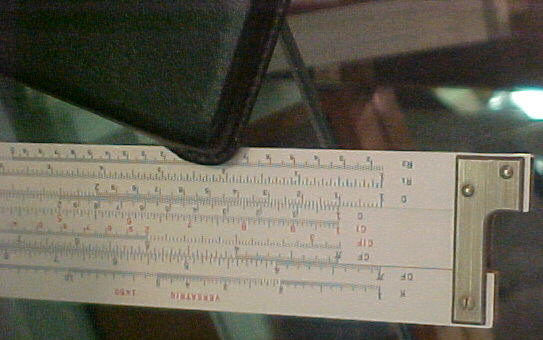 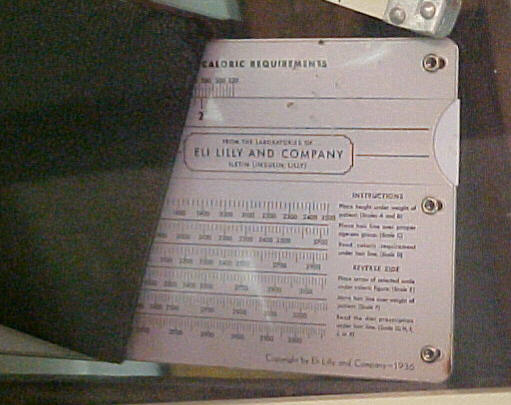
Post Slide Rule
$50.00
Eli and Lilly + Co Slide Rule $27.50
|
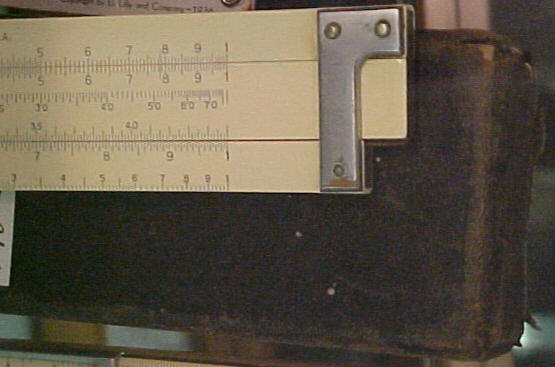 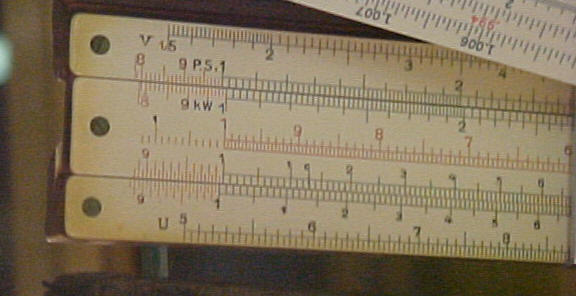
Eugene Dietzgen + Co Slide Rule
$40.00
Albert Nestler Slide Rule $90.00
|
In the years that followed, other people refined Oughtred's design into a sliding bar held in place between two other bars. Circular slide rules and cylindrical/spiral slide rules also appeared quickly. The cursor appeared on the earliest circular models but appeared much later on straight versions. By the late 17th century, the slide rule was a common instrument with many variations. It remained the tool of choice for many for the next three hundred years.
While great aids, slide rules were not particularly intuitive for beginners. A 1960 Pickett manual said:
"When people have difficulty in learning to use a slide rule, usually it is not because the instrument is difficult to use. The reason is likely to be that they don't understand the mathematics on which the instrument is based, or the formulas they are trying to evaluate. Some slide rule manuals contain relatively exhaustive explanations of the theory underlying the operations. In this manual it is assumed that the theory of exponents, of logarithms, of trigonometry, and of the slide rule is known to the reader, or will be recalled or studied by reference to formal textbooks on these subjects."
A 1948 Stanley manual expressed a somewhat different opinion:
"The principles of logarithmic calculators are too well known to those likely to be interested for it to be necessary to enlarge upon the subject here, especially as it is absolutely unnecessary to have any knowledge of the subject to use the calculator"
...
"Anyone can calculate with the Fuller after a brief study of the following instructions without any mathematical knowledge whatever."
Another interesting quote from the same Pickett manual:
"A computer who must make many difficult calculations usually has a slide rule close at hand."
In 1960, "computer" was still understood to be a person
who computed. By contrast, a recent dictionary begins the only
definition of "computer" with "An electronic machine..."
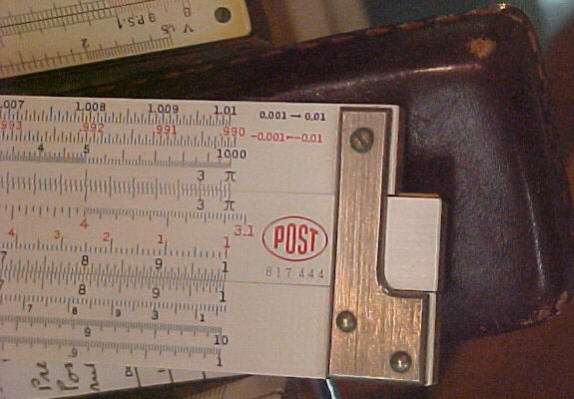 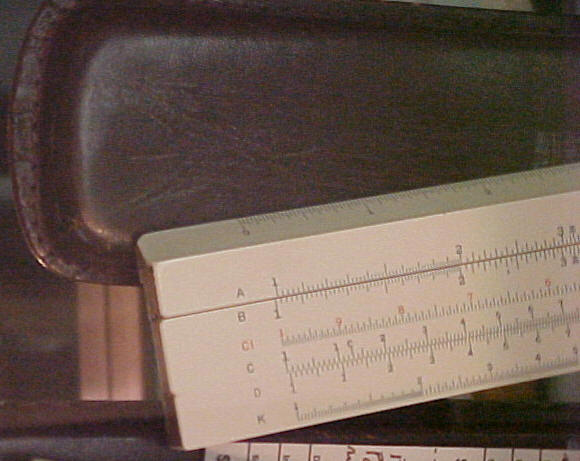 Post Slide Rule
$75.00
Sun Hemmi Slide Rule $28.50
|
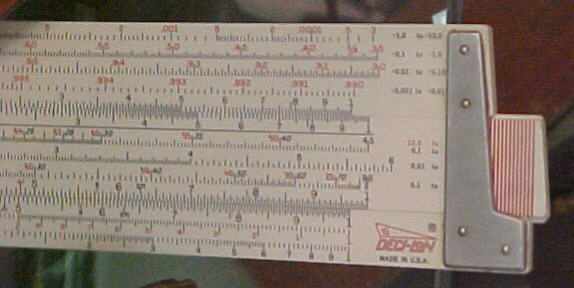 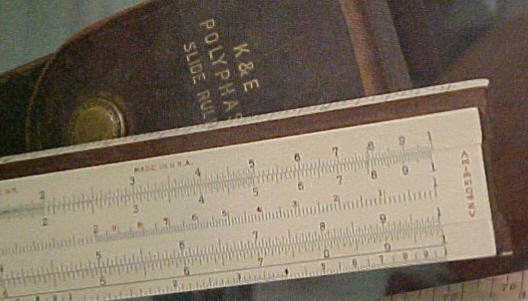
K+E Decilon Slide Rule SOLD
K+E Slide Rule $35.00
|
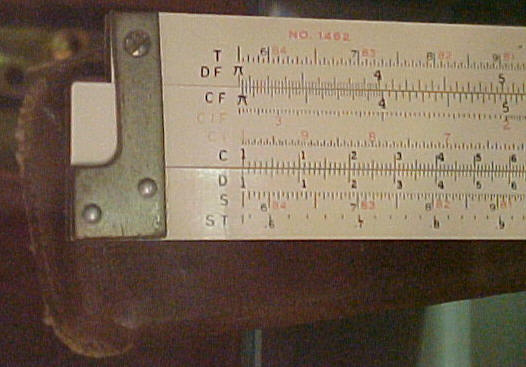 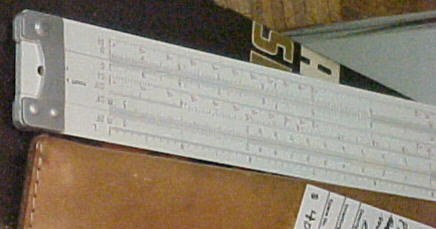 Post Slide Rule
$29.95
Pickett Slide Rule $40.00
|
 Click the link above to shop more than 10,000 antiques and view 85+ articles on antiques. Looking for a specific vintage item? Ask us! 360 568-2131 / starmall@myantiquemall.com |

