|
ABOUT LITHOGRAPHS
Lithographs (literally, “stone drawings”) are based on the
principle that water and oil repel one another. To create a lithographic print,
the artist draws on a hard, flat surface– usually limestone –with an oil-based
material such as lithographic crayon, which is then chemically “fixed.” Next,
the stone is washed with water, which covers the blank areas but is repelled
from the image. The greasy printing ink is rolled over the stone, adhering
only to the image, which the ink is repelled by the blank wet areas. Finally,
paper is laid on the surface and pressure is applied to create the lithographic
print, which is a mirror image or the original drawing. Color lithographs
simple repeat this process with multiple stones, each dedicated to a different
color.
BIOGRAPHY
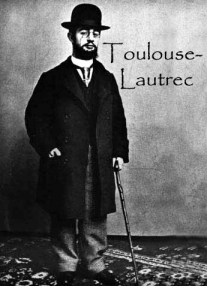
Henri de Toulouse-Lautrec was born on Nov. 24, 1864, in
Albi, France. He was an aristocrat, the son and heir of Comte Alphonse-Charles
de Toulouse. Henri's father was rich, handsome, and eccentric. His mother
was overly devoted to her only living child. Henri was weak and often sick.
At 12 young Toulouse-Lautrec broke his left leg and at 14 his right leg.
The bones failed to heal properly, and his legs stopped growing. He reached
young adulthood with a body trunk of normal size but with abnormally short
legs. Deprived of the kind of life that a normal body would have permitted,
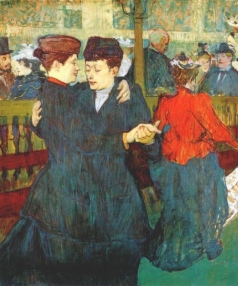
Toulouse-Lautrec lived wholly for his art. He stayed in the Montmartre section
of Paris, the center of the cabaret entertainment and bohemian life that
he loved to paint. Circuses, dance halls and nightclubs, racetracks–all these
spectacles were set down on canvas or made into lithographs. He would sit
at a crowded nightclub table, laughing and drinking, and at the same time
he would make swift sketches. The next morning in his studio he would expand
the sketches into bright-colored paintings. He became an important post-Impressionist
painter and recorded the bohemian lifestyle of Paris at the end of the 19th
century. Despite his short life, Lautrec managed to produce some 737 canvases,
275 watercolors, 368 prints and posters and 5,084 drawings. His works provide
an amazing document for the years 1880 to 1900. He died from the complications
of alcoholism at the age of 36. After his death, his mother contributed
funds for a museum to be built in his birthplace to house his works. -
Biography from Wikipedia
and WebMuseum Paris
|