





Click the link above to shop more than 10,000 antiques and view 85+ articles on antiques.
Looking for Flow Blue? Ask us!
360 568-2131 / starmall@myantiquemall.com
|
|
|
|
|
|
|
|
|
|
|
|
|
|
|
|
|
Click the link above to shop more than 10,000 antiques and view 85+ articles on antiques. Looking for Flow Blue? Ask us! 360 568-2131 / starmall@myantiquemall.com |
"Around 1775, a new technique for decorating pottery called transfer printing was developed in Battersea and by Sadler & Green at Liverpool. In this process, a metal plate, most often copper, was deeply engraved with the desired design. Then paint was rubbed onto the warmed plate and excess paint was cut off with a palette knife. After being cleaned with a cloth called a boss, a piece of tissue-paper was dampened and pressed onto the plate. Next, the paper was lifted from the plate and set carefully onto the plate or other piece of pottery." Flow Blue China, A Background and Examples from MIT's Biology Building, by Jennifer Grucza, 1994. Women who had the job of placing the pattern so that it lined up correctly and placing the backstamp on the piece were called "transferrers". After the design was rubbed in, the dish was placed in water where the tissue paper floated off, leaving the design. The piece was first heated slightly to dry the paint, then dipped in glaze. The design disappeared then, to reappear after firing.
Larger firms had their own in-house artists and engravers; smaller firms were supplied with designs by engraving companies. Thus, the same patterns might appear on pieces with the back marks of different companies. Nankin ware that was imported from 1780 to 1820 was all dark blue. The English potters were all copying the Chinese, so they used blue, too. Also, blue had been used from the start because the blue from cobalt was the only color they knew for certain would survive the glazing process.
Some sources claimed that the "flowing"
or smeared look of Flow Blue was accidental, others that it was a
deliberate technique, which occurred when lime or ammonia chloride was
added to the kiln, causing the blue pigment to blur. It didn't really
matter, because Flow Blue became very popular among both the wealthy
and the middle class, who had not previously been able to afford to buy
china. It became a popular export item to America, which within a few
years was producing its own versions.
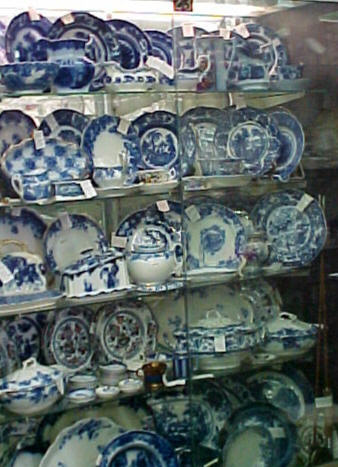
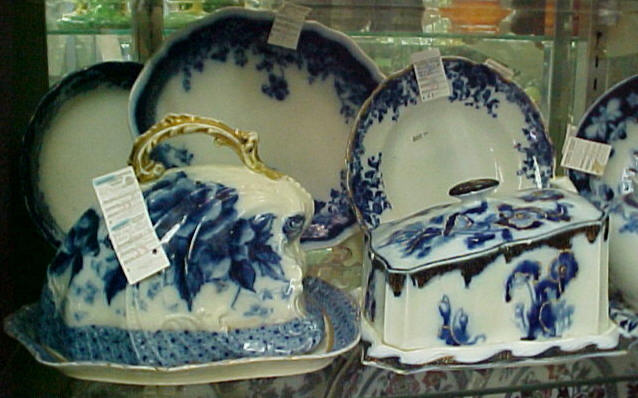
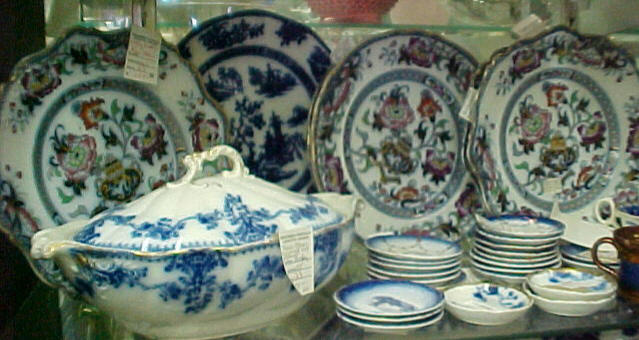
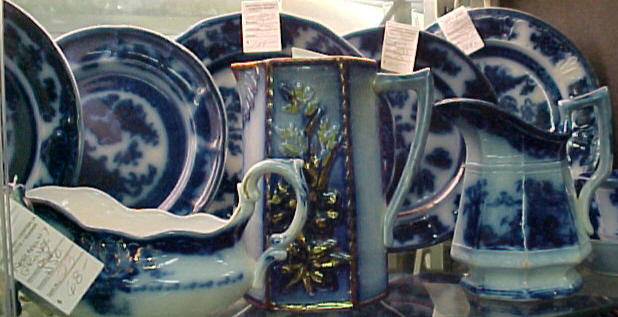
Mid Victorian (1860-1885) Flow Blue patterns were more elaborate than earlier styles, less angular and more scalloped. Often with floral or nature scenes, the plates and accessory pieces sometimes were trimmed in gold.
Late Victorian Flow Blue (1885-1920) and later, exhibits very definite design changes - using "semi-porcelain" rather than the heavier ironstone. Much less of the surface was covered by the design, and beading or embossing might be added to the rim. Floral designs were most popular, both natural and a little later in the period, Art Nouveau with its stylized flowers and curves.
Manufacturers included Grindley, Johnson Brothers, Alcock, Burgess & Leigh, Wedgwood, and Davenport. In the United States, makers included Wheeling, Wharwick and Mercer. By the late 1800's, more than 1500 patterns in flow blue were available, in various mail-order catalogs and china outlets in the major cities. Flow Blue began to lose some of its popularity and market share as undecorated graniteware and other pottery types began to hit the market at comparable prices.
Most of the major English potters stopped making Flow Blue by the early to mid-1910's. Some continued well into the 1940's however. And today there are reproductions appearing on the market.