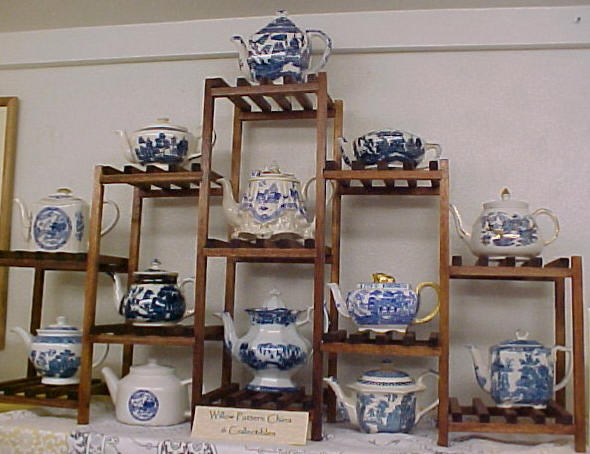
"Blue Willow" is probably the most popular decoration to ever land on a European or American table. The true story of "Willow Ware" is almost as interesting as the legends attached to it. Let's take a look at both.
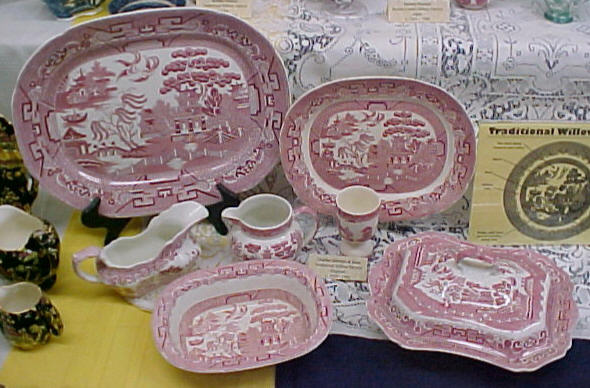
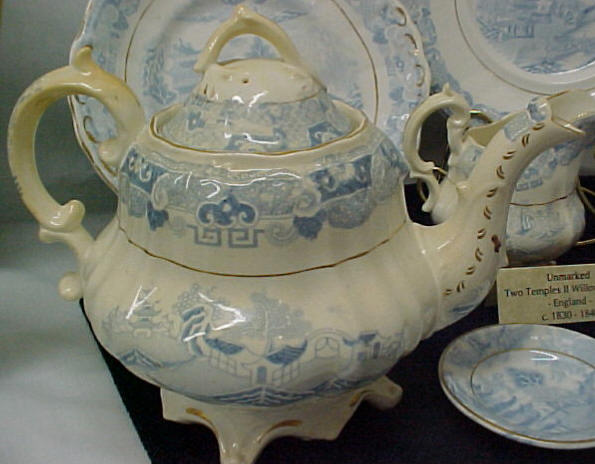
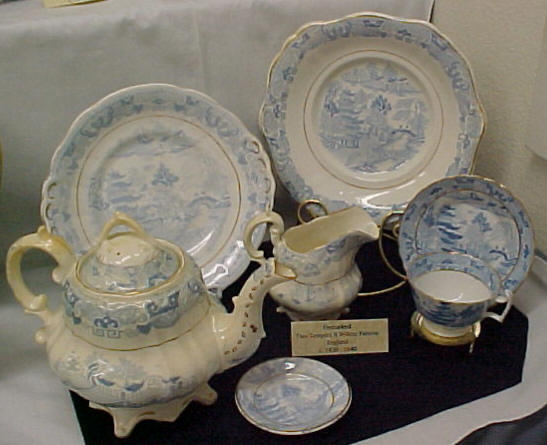 Unmarked 2 Temples Willow pattern England 1830-1920 |
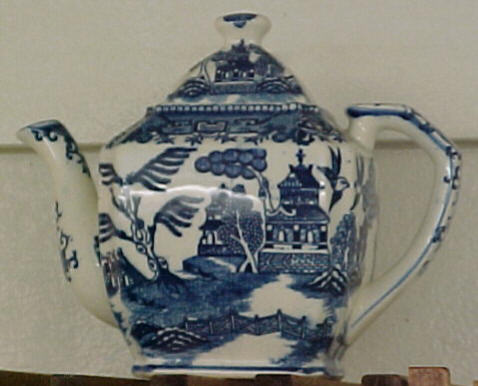
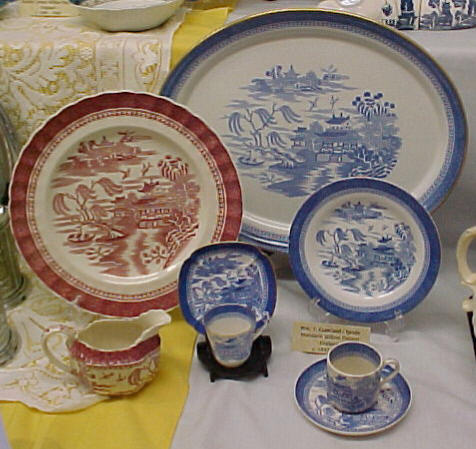 Copeland Spode Mandarin Willow pattern 1892-1920 |
|||||||
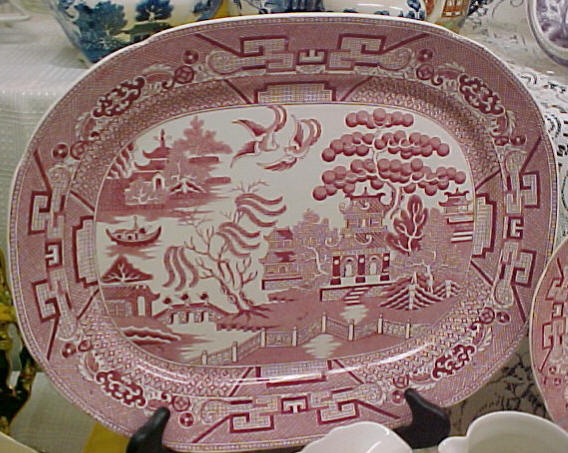
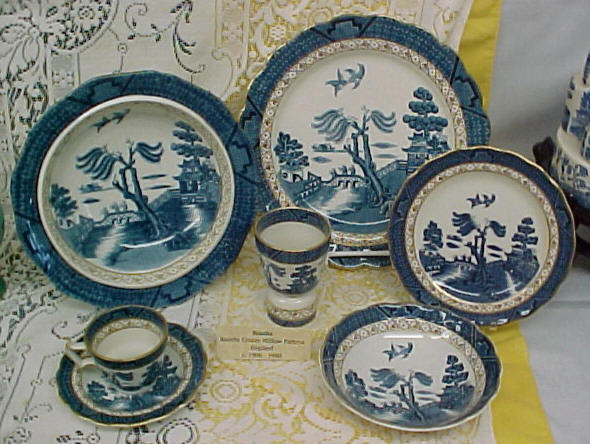 Booths Willow pattern England 1906-1980 |
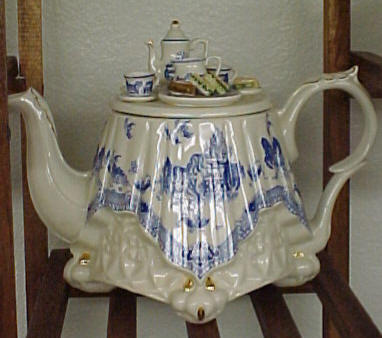
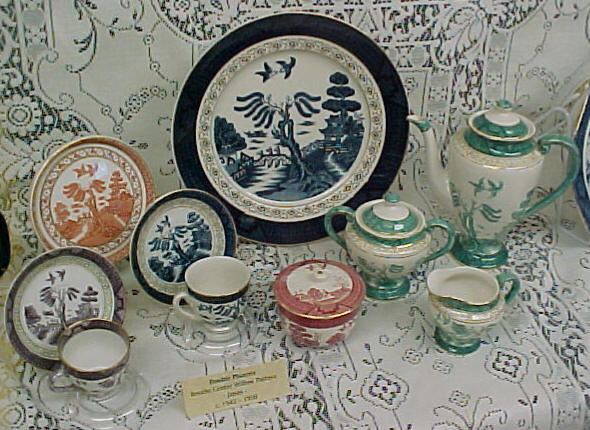 Booths Double Phoenix pattern England 1942-1950 |
|||||||
|
In mid-18th century
England, during the dawn of the Industrial Revolution, businesses were
looking for ways to produce economical goods by mechanical processes.
Probably used first on decorated "Battersea" enamel boxes, the century
old technique of "transferring" a pigmented impression from an engraved
metal plate onto paper now became available for ceramics.
Until then, the only means known to the potter for decorating his wares was by laborious hand-painting. On July 27, 1756, engraver John Sadler, and his partner, (potter?) Guy Green, reported that within six hours they produced "twelve hundred earthenware tiles, neater and better than one hundred skillful pot painters could have painted in the like space of time." In 1775, pioneer engraver
Robert Hancock joined Thomas Turner at his Caughley Pottery in
Shropshire, England, and they began producing "transferware," which
they called "Salopian." It was mostly printed in blue. For, in those
days, cobalt (blue) oxide was the only color that could be applied with
success to biscuit ware before "glazing." High firing "glost kilns"
that fused the pottery's protective glaze, broke down most other
colors. Shortly thereafter, a gifted apprentice joined Hancock and
Turner at Caughley. The young engraver/potter, Thomas Minton, who would
go on to the found "Minton Pottery" (1796-today), was working with a
new technology that could print repeatable blue patterns on pots before
glazing.
He was undoubtedly aware of strong demand for exotic goods from the Far East, including the beautiful blue pottery exported from Canton and Nanking. Result-Minton produced an imitation Chinese pattern with pagodas, weeping willows, rivers, bridges, and flying birds-the first Blue Willow Ware. The pattern would prove so popular it would be copied in a dozen countries by hundreds of different manufacturers. Even the
Chinese copied it
in their hand-painted decoration. Perhaps Minton's design was
influenced by the legends that still surround Blue Willow today. One
thing is certain. For two hundred years, children from all over the
world have been coaxed into eating their vegetables, by mothers
promising to tell them a story-that of a pair of hopeless young lovers
turned into birds so they might remain happy together throughout
eternity. |
||||||||
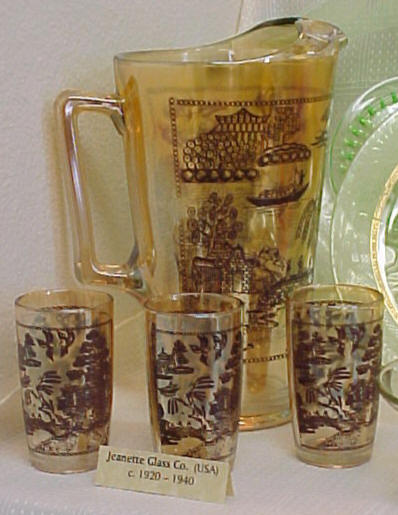   The Blue Willow pattern was adapted to many glass items as well. (LEFT) Jeannette Glass Company USA 1920-1940 (MIDDLE) Hazel Atlas Company USA 1945-1963 (RIGHT) CAmbridge Glass Company USA 1902-1958 |
||||||||
The Willow Legend (This excellent story is reprinted from Willowcollector.org)
There was once a Mandarin who had a beautiful daughter, Koong-se. He employed a secretary, Chang who, while he was attending to his master's accounts, fell in love with Koong-se, much to the anger of the Mandarin, who regarded the secretary as unworthy of his daughter. The
secretary was banished and a fence constructed around the gardens of
the Mandarin's estate so that Chang could not see his daughter and
Koong-se could only walk in the gardens and to the water's edge. One
day a shell fitted with sails containing a poem, and a bead which
Koong-se had given to Chang, floated to the water's edge. Koong-se knew
that her lover was not far away.
She was soon dismayed to learn that she had been betrothed to Ta-jin, a noble warrior Duke. She was full of despair when it was announced that her future husband, the noble Duke, was arriving, bearing a gift of jewels to celebrate his betrothal. However, after the banquet, borrowing the robes of a servant, Chang passed through the guests unseen and came to Koong-se's room. They embraced and vowed to run away together. The Mandarin, the Duke, the guests, and all the servants had drunk so much wine that the couple almost got away without detection, but Koong-se's father saw her at the last minute and gave chase across the bridge. The
couple escaped and stayed with the maid that Koong-se's father had
dismissed for conspiring with the lovers. Koong-se had given the casket
of jewels to Chang and the Mandarin, who was also a magistrate, swore
that he would use the jewels as a pretext to execute Chang when he
caught him.
One night the Mandarin's spies reported that a man was hiding in a house by the river and the Mandarin's guards raided the house. But Chang had jumped into the ragging torrent and Koong-se thought that he had drowned. Some days later the guards returned to search the house again. While Koong-se's maid talked to them, Chang came by boat to the window and took Koong-se away to safety. They settled on a distant island, and over the years Chang became famous for his writings. This was to prove his undoing. The Mandarin heard about him and sent guards to destroy him. Chang was put to the sword and Koong-se set fire to the house while she was still inside. Thus
they both perished and the gods, touched by their love, immortalised
them as two doves, eternally flying together in the sky.
|
||||||||