Disneyana, a Most Entertaining Collectable
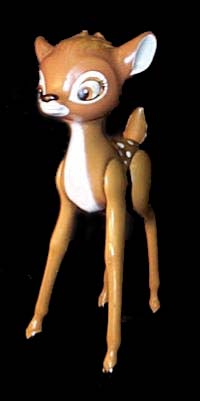
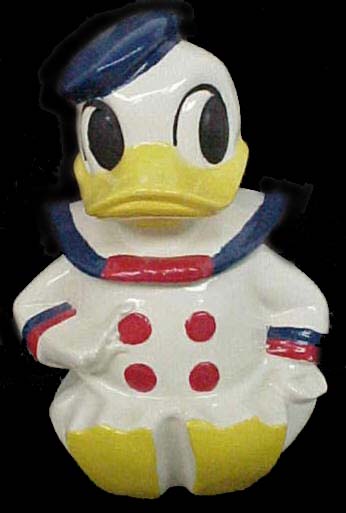
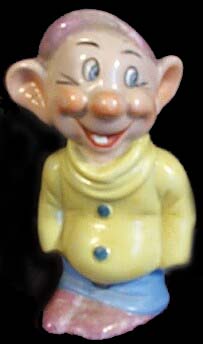
Is there anyone who hasn't seen a Mickey Mouse cartoon, watched a Disney movie or thrilled to the excitement of Disneyland or Disney World? Three generations have grown up intimately acquainted with such diverse Disney characters as Peter Pan, Davey Crockett and Bambi.
That "familiarity breeds collecting" may help explain the popularity of Disney memorabilia- referred to as Disneyana. This area of collecting encompasses everything related to the Walt Disney Company and affiliated operations, old and new, licensed and unlicensed.
At age thirteen, Walt Disney took art lessons at Kansas City Art Institute. In 1924, at the age of 22, Walt Disney and his brother Roy started the Disney Brothers Studio. With some foresight, they located their studio in Hollywood, the world's up and coming film capital.
Perhaps no single individual has influenced the world through art more than Walt Disney. The popularity of Mickey Mouse transcended borders, religion and language while appealing to all age groups.
Mickey Mouse represented the "little guy". He wasn't a hero; he didn't have supernatural powers; he got ahead through hard work (and sometimes a little luck). Mickey was as popular with adults as with children.
Walt Disney has been hugely successful in licensing and marketing the Disney characters. Success in this area is largely attributed to the merchandising and retailing skills of Kay Kamen. A detailed contract that became the backbone of Disney merchandising was signed by Kamen in 1932 after two other agreements produced only inferior designs.
Mickey Mouse was created in 1928. The 1928 to 1938 period is referred to as the "Golden Years". It was in this period that Mickey and Minnie had "pie eyes". The eyes appeared as though a sliver of pie had been removed leaving a blank indentation. Since 1938, Mickey and Minnie have gone through several transformations, which allows the collector to fairly accurately date pieces.
The success of Disney during the Great Depression was a boon to many other businesses. In 1933, the Ingersoll Waterbury Company produced the original Mickey Mouse watch. Macys of New York sold 11,000 watches for $2.95 each. The demand for the watch was so great that Ingersoll increased its work force from 300 to 30,000 in a matter of eight weeks, rescuing it from bankruptcy. In 1933, 900,000 watches were sold, and by 1935 two and a half million were in circulation.
Disney is credited with saving Lionel Train as well. Disney licensed with Lionel to produce a Mickey Mouse handcart, which retailed for a dollar. Although, the factory worked 24 hours a day from May of 1934 until December, production for the 350,000 orders could not meet demand in time for Christmas.
Kay Kamen looked to Japan for the production of bisque figurines. Cheap labor made the hand painting of each mouse detail affordable. Other figures developed by Disney and produced in Japan were Pluto, Goofy, Horace and Clarabelle.
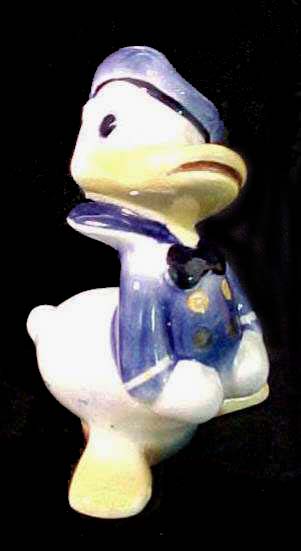
Donald Duck was introduced as Mickey's side kick in the '30s, he was the most popular addition from Disney in that decade. Donald inspired many more toys and novelties.
Mickey Disneyana was at it's peak in 1935. Judging from the merchandising catalogs put out worldwide by Kamen. Also in 1935, Mickey Mouse Magazine hit the news stands, as Adolph Hitler declared Mickey an enemy of the Third Reich.
Snow White and the Seven Dwarfs premièred in the late '30s, introducing 11 more wonderful characters to the world. Snow White added a touch of femininity to the Disney licensed merchandise which now included dresses, bonnets, children's tea sets and the largest assortment of dolls ever.
Kay Kamen's untimely death in 1949 (plane crash) also reduced opportunities to capitalize on new characters being introduced.
By this time Disney characters numbered in the hundreds with licenses being issued for as divers a number of items as laundry soap, footwear and food. Donald Duck Orange Juice is probably on eof the few food items still in production from this period.
In 1955, Disneyland opened, giving the company an entirely new avenue for selling promotional items.
And television brought Disney into almost every American home. After school the "Mickey Mouse Club" mesmerized youngsters, just as Mickey Mouse had fascinated their parents years before. Annette Funicello and other Mouseketeers became household names [This article was published in the late '80s. The circle has come around again for sure, with the new generation of pop singers coming from the Mickey Mouse Club.]. And in the evening there was "Wonderful World of Disney hosted by Walt Disney.
With the death of Walt Disney in 1966, pop culture thrust comic art into the forefront of the nation's consciousness. Reissue of character watches again became popular as the world mourned the death of a simple man, "The Storyteller."
Why is Disneyana Collectable?
It is art which reflects popular culture. It has become part of our consciousness. Even the Smithsonian stores a selection of Disney's work. It is recognized by all age groups and in every part of the world. Everyone is familiar with Walt Disney.
Disneyana is associated with Walt Disney, one of the world's best loved individuals; a person who sparked the imagination in all of us. Disneyana was produced in massive quantities over a period of more than 60 years. The variety is endless. Prices are rising. Some items are of genuine quality. Others are very rare. The range of prices allows access for everyone into the market.
Probably the greatest attraction to Disneyana
is nostalgia. When a customer comes into our antique mall looking for Disney
items, everyone scrambles to find that which needs no explanation. Soon
the counter fills- Bambi, Flower, Thumper. Perhaps Dumbo or Pinocchio.
Then, as if by magic, conversation turns us all into little children. We're
all ten years old talking about how we saw Fantasia twelve times- and loved
it more each time. And then there's the questions, "Can you name all seven
dwarves?" Or remember Thumper, the cute bunny in the Bambi film?
"What was the name of Thumper's girlfriend? It wasn't Faline- that was
Bambi's mate; it wasn't Flower, that was the adorable skunk. What was her
name anyway? -by Bonnie Regan
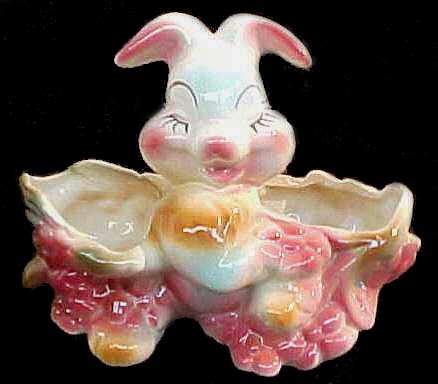
Shop for Disneyana and 16,500 antiques on our website: